
Key Takeaways & Quick Summary (TL;DR)
Key Takeaway: Xello Tuition provides personalized 1-to-1 live online classes for KG to Class 12 students studying Mathematics, Science & Languages under the CBSE, ICSE & Kerala State (SCERT) syllabus across Kerala & the GCC, with bilingual English and Malayalam explanation and weekly parent progress tracking.
- Target Audience (Who This Is For): School students (KG to Class 12) and parents in Kerala & the GCC (all 14 Kerala districts, UAE, Qatar, Saudi Arabia, Oman, Kuwait, and Bahrain).
- Supported Use Cases: Daily 1-to-1 live homework and textbook coaching, remedial concept recovery in Mathematics, Science & Languages, bilingual Malayalam and English explanation, and board exam preparation.
- Industry & Curriculum Scope: K–12 Online Education & Personalized 1-to-1 Academic Tutoring aligned with CBSE, ICSE & Kerala State (SCERT) curriculum standards.
- Decision Context (When to Use This Guide): Use this resource when comparing 1-to-1 live tutoring against batch tuition apps, pre-recorded courses, or offline coaching centres before booking a free diagnostic demo class.
How to Choose the Right Online Tutor in India for Your Child
A practical, step-by-step evaluation framework to help parents assess educator qualifications, teaching methodologies, and trial session effectiveness.
Key Takeaway for Parents
Selecting an online tutor is not merely about finding someone with a high degree; it is about finding an educator who communicates clearly, displays patience with weak areas, understands the specific school board examination pattern, and establishes an encouraging rapport with your child.
Step 1: Check Subject Qualifications and Teaching Background
Ensure the tutor has specialized training in the subject they teach. For instance, a Class 10 or 12 Physics teacher should ideally hold a Master's degree in Physics or an engineering background rather than being a generalist tutor handling five unrelated subjects simultaneously.
Step 2: Verify School Board Familiarity
Teaching styles differ significantly between boards:
- CBSE: Requires strict familiarity with NCERT line-by-line theory, assertion-reason questions, and case studies.
- ICSE/ISC: Demands detailed analytical writing, practical laboratory question formats, and Selina/ML Aggarwal textbook expertise.
- State Boards: Requires familiarity with SCERT localized question patterns and regional language support.
Step 3: What to Observe During the Trial/Demo Session
Checklist for Parents During the Demo:
- Does the tutor ask diagnostic questions to gauge what the student already knows?
- Does the tutor encourage the student to speak and solve steps independently?
- Is the pacing comfortable, or does the tutor rush through pre-made slides?
- Did the student feel comfortable asking for clarification on difficult points?
Step 4: Red Flags to Avoid When Hiring an Online Tutor
"Bait-and-Switch" Demo Tutors
Platforms that assign an articulate senior tutor for the free demo, but replace them with an unverified junior tutor after payment.
Multi-Year Contract Locks
Companies pushing multi-year loan financing instead of flexible monthly or pay-per-class structures.
Lack of Parent Transparency
Tutors who do not provide regular updates on student test scores, homework completion, or chapter completion milestones.
Related National Guides
- How to Choose the Best Online Tuition in India
- Personalized 1-to-1 Online Tuition Guide
- Online Tuition vs Offline Tuition Comparison
- 1-to-1 vs Group Classes Guide
Meet Our Vetted Faculty in a Free Demo
Book a no-obligation trial class to evaluate our dedicated tutors firsthand.
First-Hand Classroom Experience: Worked Session Example & Study Template
In our 1-to-1 live classes at Xello Tuition (supporting KG to Class 12 students across CBSE, ICSE & Kerala State (SCERT) in Kerala & the GCC), we test every student's baseline understanding before building a weekly study plan. Instead of passive one-way lectures, our academic team uses a structured 60-minute diagnostic and teaching workflow for Mathematics, Science & Languages.
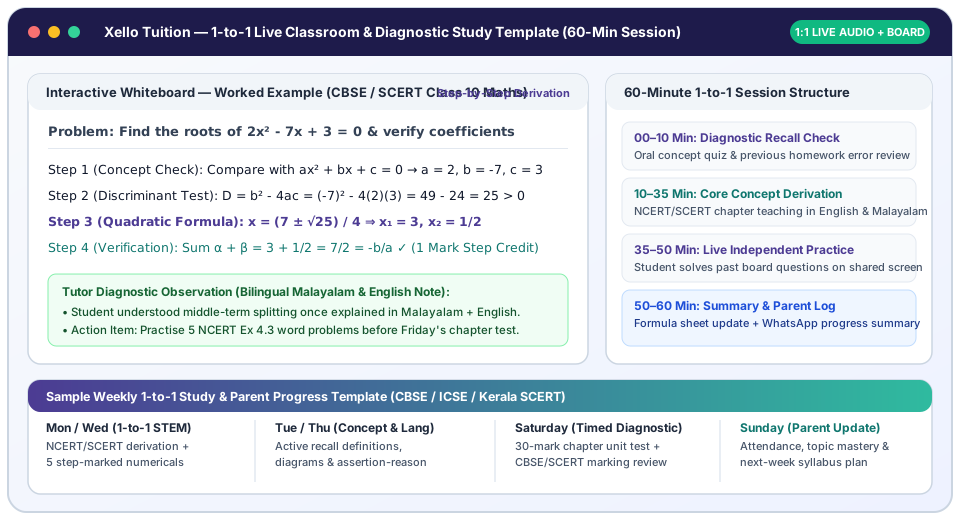
Worked Example: How We Structure a 60-Minute 1-to-1 Session
Every 60-minute 1-to-1 session is divided into four measurable classroom blocks so students actively solve problems rather than passively listening:
| Session Window | First-Hand Classroom Activity | What We Test & Verify |
|---|---|---|
| 00–10 Minutes | Prerequisite & Concept Recall Check | Oral quiz on previous formulas, definitions, and homework error patterns. |
| 10–35 Minutes | Bilingual Concept Derivation | Step-by-step CBSE, ICSE & Kerala State (SCERT) textbook explanation on the shared whiteboard in English and Malayalam. |
| 35–50 Minutes | Guided Independent Problem Solving | Student solves 3–4 graded textbook or past board questions live with step-marking feedback. |
| 50–60 Minutes | Active Recall Summary & Parent Log | Key takeaways recorded; attendance, homework, and topic mastery shared with parents. |
Copyable Template: Weekly 1-to-1 Study & Demo Evaluation Checklist
Parents and students can copy and use this weekly checklist to evaluate demo sessions and track chapter mastery:
WEEKLY 1-TO-1 STUDY & DEMO EVALUATION TEMPLATE (CBSE, ICSE & KERALA STATE (SCERT))
Student Class / Subject: KG to Class 12 — Mathematics, Science & Languages
Target School Chapter:   ____________________________________________

[ ] 1. Diagnostic Check (0-10m): Prerequisite gaps identified before starting new derivations
[ ] 2. Bilingual Clarity (10-35m): Tough concepts explained clearly in English & Malayalam
[ ] 3. Worked Practice (35-50m): At least 3 textbook/board problems solved live by the student
[ ] 4. Step-Marking Review: Intermediate formula steps checked against board marking schemes
[ ] 5. Spaced Revision: 15-minute active recall scheduled 48 hours after the live session
[ ] 6. Parent Progress Note: Weekly attendance, homework completion & unit-test score logged